

We develop and support policies at the state and federal level that benefit the entire small business ecosystem—ranging from access to responsible capital, healthcare and other essential benefits, and promoting fair competition.






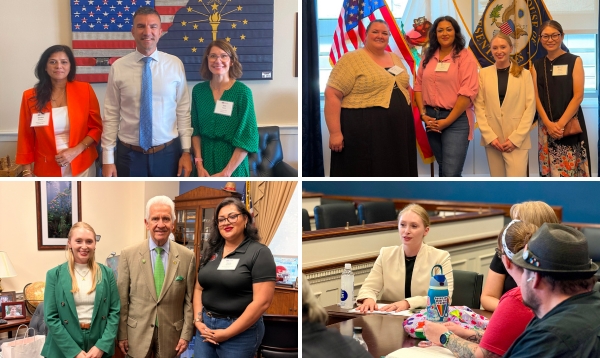
On July 14 and 15, Small Business Majority welcomed nearly two dozen small business owners to Capitol Hill to meet with members of Congress and their staff to discuss the rising cost of doing business. Additionally, they met with the House Committee on Small Business, House Committee on Financial Services, Senate Committee on Small Business and Entrepreneurship and the New Democrat Coalition.
As fuel and transportation costs climb, small businesses are facing mounting financial pressure. This edition of Voice of Main Street finds that 67% of small businesses report rising expenses and half report declining revenue over the past three months. Nearly three-quarters (74%) have been impacted by higher fuel and transportation costs, while rising prices for utilities, raw materials, healthcare and rent continue to strain operations. The survey also explores how these challenges are affecting hiring, investment decisions, profitability and optimism, and highlights the critical role access to capital plays in shaping small business confidence and growth.
This national opinion poll of likely voters, conducted for Small Business Majority by Lake Research Partners, reveals overwhelming bipartisan support for small businesses and pro-small business policies. Voters believe by dramatic margins that the success of small business is better for their families and the economy than the success of large corporations, and it’s personally important to them that local small businesses in their communities thrive.
On April 14, Small Business Majority, The National Alliance of Healthcare Purchaser Coalitions, and Families USA held a briefing on Capitol Hill for congressional staff on the need for healthcare price transparency reform. These organizations and small business owners called on Congress to pass the bipartisan Patients Deserve Price Tags Act, which would offer site-neutral payment reforms and greater billing transparency.
Small businesses are navigating a sharp squeeze on Main Street, according to Small Business Majority’s latest Voice of Main Street poll released on March 25, 2026. Most entrepreneurs report rising expenses alongside falling revenues, with costs driven by tariffs, healthcare premiums, utilities, and supplies. At the same time, many say weak consumer demand, difficulty meeting payroll, and concerns about corporate consolidation are limiting growth and forcing tough choices—from raising prices to delaying hiring and investment.
“America’s small businesses are grateful that the U.S. Supreme Court has placed limitations on a president’s ability to impose tariffs. This decision is critically important because small businesses can do very little to avoid the rapidly rising costs of goods that result from tariffs. In fact, sweeping tariffs have already forced many small firms to make difficult decisions, including limiting or even ceasing operations."
“Congress is at a crossroads and the decisions our elected officials make in the coming days and weeks will have a profound impact on not only America’s small businesses but on the collective whole of our nation. On one hand, government shutdowns, even partial shutdowns, typically harm small businesses in some form. At the same time, the federal government’s widespread use of violent and chaotic immigration enforcement action is disrupting small business operations nationwide. In order to address an immigration enforcement situation that has rapidly devolved to the point of crisis while also minimizing the damage caused by a government shutdown, the U.S. Senate should separate U.S. Department of Homeland Security funding from the other legislation needed to fund the federal government so that the government can remain up and running while lawmakers negotiate necessary reforms to U.S. Immigration and Customs Enforcement operations."
“It is very promising to see that appropriators in the U.S. House of Representatives are seeking more than $1.3 billion in total funding for direct small business support programs. At a time when small businesses are struggling with tariffs, inflation, the growing cost of healthcare and broad economic uncertainty, targeted small business resources are a lifeline that cannot realistically be replaced with investment from the private sector."
“The fact that 60 U.S. Senators did not agree to extend the Affordable Care Act’s (ACA) enhanced premium tax credits (EPTCs) will have serious consequences for America’s small businesses. The EPTCs, which lower monthly premiums for health insurance plans purchased through the ACA Marketplace, have been essential for many small businesses and their employees. In 2025 alone, more than 4.4 million out of 5.2 million small business owners and self-employed entrepreneurs enrolled in coverage through the Marketplace received the enhanced premium tax credit. Without the EPTCs, however, KFF estimates that ACA marketplace enrollees would pay 114% more on average for their monthly healthcare premiums.
On December 8, Small Business Majority submitted a statement for the record in advance of a Senate Permanent Subcommittee on Investigations hearing titled “Defining Our Healthcare Problem, and Principles We Should Follow to Solve it.” The statement outlines the critical role the Affordable Care Act (ACA) Marketplace and the expansion of the premium tax credits have played in strengthening access to affordable healthcare coverage for small business owners and employees. With the end of open enrollment fast approaching, Congress is running out of time to extend the enhanced tax credits which are essential to lowering costs for the millions of small business owners and self-employed entrepreneurs in the Marketplace.
Copyright © 2006-2026 Small Business Majority, All rights reserved. Small Business Majority is a 501(C)(3) nonprofit organization.